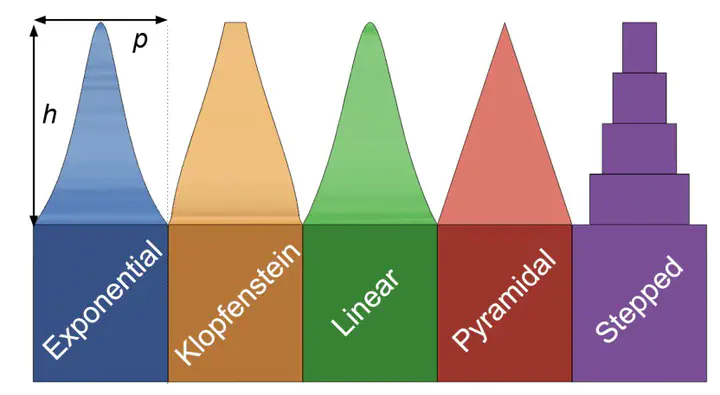
 Image credit: Figure 2
Abstract
We present results of an extensive suite of numerical simulations that probe square-tiled microwave absorber performance as a function of material properties, frequency, geometry, and unit cell size. The work, which probes both specular reflection and total absorption, highlights the critical importance of the absorber scale size relative to the incidence wavelength while suggesting that material properties have a comparatively weaker impact on overall performance. We show that some absorber designs can achieve 99.5-99.9% frequency-averaged absorption across the 70 to 200 GHz range for normal incidence and that low specular reflectance does not necessarily guarantee optimal absorption performance. Our results indicate that exponential, Klopfenstein, and linear impedance tapers provide comparable performance as long as a unit cell size of 1 to 4 mm is chosen. Simulation results are validated against measurements of specular reflectance.

Gaganpreet Singh
Postdoc
Gagandeep Kaur
Postdoc
I have worked on spatial mode engineering in periodic photonic bandgap materials such as photonic crystals during my PhD. I am interested in numerical and experimental study of periodic structures, waveguide/cavity based devices designed in such structures for myriad applcations. I am currently working on a prototype of Plasma Haloscope based on wired metamaterials for Axion detection.

Rustam Balafendiev
PhD Student
Rustam Balafendiev received the M.Sc. degree in radiophysics from the School of Physics and Engineering, ITMO University, Saint Petersburg, Russia, in 2021. His current research interests include novel applications of wire metamaterials and holography experiments.

Thomas Gascard
Postdoc
In the hope to contribute to the current efforts of the Cosmology comunity to unveil the early stages of the Universe and its evolution, I did a PhD. in instrumentation for cosmology applications at Cardiff University, which covers design methods, fabrication and experimental characterisation of a Metamaterial-based Lenslet (MetaL) prototype coupled to an antenna fed detector plane. I then joined the CMBeam group to carry on experimental characterisation and qualification of optics for futur cosmology experiments.

Zeshen Bao
BSc Student
My research interests include distributed robotics, mobile computing and programmable matter.


Jón E. Guðmundsson
Professor
Professor of astrophysics at the University of Iceland and senior research scientist at Stockholm University.